LCTS Industry Insight
Many industrial facilities are operating assets that were designed decades ago.
Age alone does not determine whether an asset is still capable of performing safely and reliably. The bigger question is whether the facility’s current condition, operating demands, and engineering controls still match what the asset was originally designed to handle.
A recent industry discussion highlights this issue: aging assets are increasingly being viewed not simply as maintenance problems, but as challenges involving asset integrity, process safety, reliability, and business performance. OGN News
At the same time, industry research continues to point toward energy-efficiency improvements as an important pathway for reducing refinery emissions, particularly through improvements to furnaces, boilers, distillation, heat recovery, and cooling systems. DOI
This raises an important engineering question:
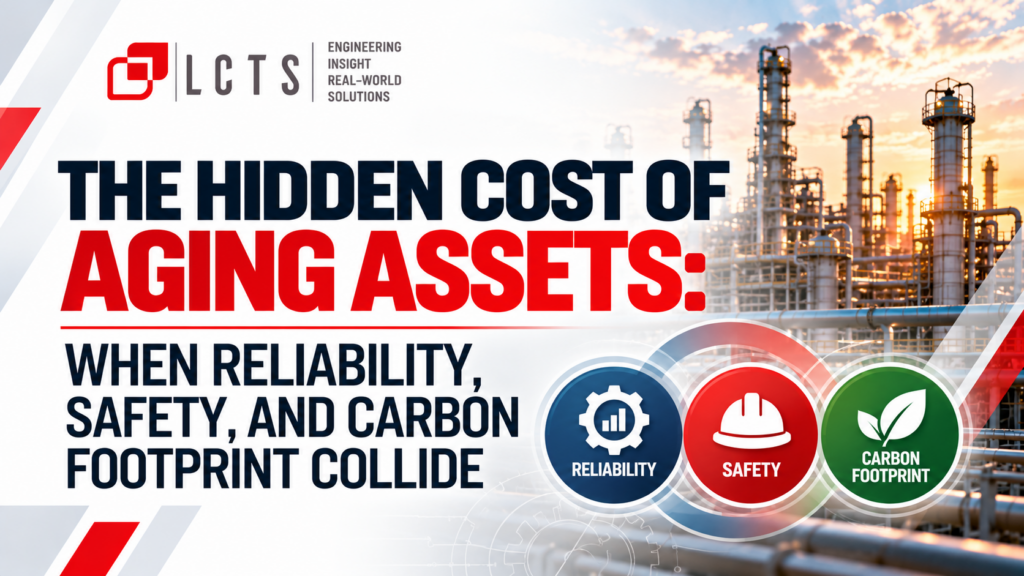
What happens when an aging asset needs to become more reliable, safer, and more efficient at the same time?
Reliability Starts With Understanding the Asset
As equipment ages, degradation mechanisms can change how systems perform.
Corrosion, erosion, fatigue, fouling, equipment wear, and repeated operating cycles can gradually reduce performance.
The challenge is that an asset may continue operating even while its original performance margin is changing.
That makes understanding equipment condition critical.
A reliability strategy should not focus only on repairing equipment after failure. It should help identify where degradation, operating conditions, and equipment limitations could create future problems.
Safety Cannot Be Separated From Asset Integrity
An aging component is not automatically unsafe.
But changes in equipment condition can affect the safety margins that were established when the facility was designed.
This is why asset integrity and process safety need to be considered together.
Recent updates to API’s process-safety guidance continue to emphasize leading indicators that can identify weaknesses in safety systems before major incidents occur. American Petroleum Institute
For aging facilities, that means asking not only whether equipment is still operating, but whether the safeguards, inspection practices, operating conditions, and maintenance strategies remain appropriate.
Where Carbon Footprint Enters the Equation
There is another consideration that is becoming increasingly important: energy efficiency.
Older equipment may continue to perform its basic function while operating less efficiently than newer technology.
Inefficient furnaces, boilers, heat-exchange systems, cooling systems, or process equipment can increase energy consumption and contribute to a facility’s carbon footprint.
This creates an opportunity.
A reliability or modernization project may also provide an opportunity to improve energy performance.
Instead of looking at each issue separately, engineers can evaluate whether one improvement can address multiple objectives.
The Three-Way Engineering Balance
This is where reliability, safety, and carbon footprint intersect.
A facility may need to replace aging equipment to improve reliability.
That replacement may also provide an opportunity to improve energy efficiency.
But the modification must still meet safety requirements and integrate properly with the existing process.
The best engineering decision is therefore not necessarily the one that produces the largest improvement in a single category.
It may be the solution that creates the best overall balance.
Why Aging Facilities Need a Systems Perspective
Industrial facilities rarely operate as isolated pieces of equipment.
A change to one system can affect utilities, controls, process conditions, maintenance requirements, and operating procedures elsewhere.
That is why decisions involving aging assets should consider the broader system.
Before investing in a major modification, organizations should understand:
What is limiting reliability?
Where are the greatest safety risks?
Where is energy being unnecessarily consumed?
Can one engineering improvement address more than one problem?
These questions can help turn asset aging from a reactive maintenance issue into a strategic engineering opportunity.
The LCTS Perspective
At Lucke Consulting Technology Services (LCTS), we believe reliability, safety, and carbon footprint should be evaluated as connected engineering priorities.
The objective is not simply to keep aging equipment running.
It is to understand how an asset is performing, where its risks are developing, and where practical engineering improvements can strengthen long-term performance.
Reliable assets support consistent operations.
Safe assets protect people and facilities.
Efficient assets can reduce unnecessary energy consumption and emissions.
Good engineering considers all three.
Final Thought
Aging infrastructure does not automatically mean an asset needs to be replaced.
But it does mean the asset deserves a closer engineering look.
The right assessment can help organizations determine whether to maintain, modify, upgrade, or replace—and whether that decision can simultaneously improve reliability, strengthen safety, and reduce carbon impact.
The goal is not simply to make an old facility last longer.
The goal is to make the facility perform better, more safely, and more efficiently.
How LCTS Can Help
LCTS provides independent engineering insight to help industrial organizations evaluate asset performance, technical risks, reliability challenges, and improvement opportunities.
Before you invest in the next repair, upgrade, or modification, make sure you understand the engineering case behind the decision.
Contact LCTS to discuss your facility or technical challenge.
LCTS — Engineering Insight. Real-World Solutions.