
LCTS Industry Insight
When industrial companies talk about carbon reduction, attention often goes to major energy-consuming equipment, process optimization, and large capital projects.
But some emissions come from something much smaller.
A valve.
A flange.
A pump seal.
A compressor seal.
A connection that is slowly leaking.
These releases may appear insignificant when viewed individually. Across an entire facility, however, thousands of potential emission points can create a meaningful environmental, safety, and operational challenge.
This is why fugitive emissions should not be treated only as an environmental issue.
They are also an engineering, reliability, and safety issue.
A Small Leak Can Be a Bigger Problem Than It Looks
Industrial facilities contain thousands of connections and components.
Most are designed to operate reliably for years, but equipment condition can change. Seals deteriorate. Gaskets age. Connections loosen. Components experience vibration, temperature changes, pressure fluctuations, and repeated operating cycles.
A leak may initially have little visible impact on production.
But it can indicate that something within the equipment or system is no longer performing as intended.
The question is therefore not simply:
“How much is this leak emitting?”
It is also:
“Why is this component leaking?”
Reliability and Emissions Can Tell the Same Story
A recurring leak can sometimes point toward a reliability problem.
If a seal repeatedly fails, replacing it without understanding the underlying cause may only address the symptom.
Vibration, alignment, operating conditions, material compatibility, temperature, pressure, or equipment design may all contribute.
Addressing the root cause can potentially improve equipment reliability while also reducing unnecessary emissions.
This is where environmental performance and asset performance intersect.
A better-performing asset can be a lower-emitting asset.
Safety Makes the Issue Even More Important
Not every leak represents the same level of risk.
The consequences depend on the substance, concentration, location, operating conditions, and surrounding equipment.
Some releases can create health, fire, or process-safety concerns.
That means identifying and managing leaks is not simply about meeting an emissions target.
It is also about understanding the potential consequences to people, equipment, and operations.
An effective approach considers both what is being released and why the release is occurring.
Detection Is Only the Beginning
Modern monitoring technologies can help facilities identify potential leaks more quickly.
Sensors, optical gas imaging, continuous monitoring, and other technologies can provide valuable information about where emissions may be occurring.
But finding a leak is only the first step.
The engineering questions come next:
What caused it?
Is it an isolated failure or a recurring problem?
Does the equipment need repair, replacement, or redesign?
Could the same failure occur elsewhere in the facility?
Technology can help identify the problem.
Engineering determines how to respond.
The Opportunity for Better Asset Management
Fugitive-emission programs can provide more than environmental data.
Patterns in leaks can reveal information about equipment performance and maintenance practices.
If the same type of valve repeatedly develops leaks, for example, the issue may deserve a broader engineering review.
This can turn emissions monitoring into an additional source of information about asset health.
Instead of treating every leak as an individual maintenance ticket, organizations can ask whether the data reveals a larger reliability problem.
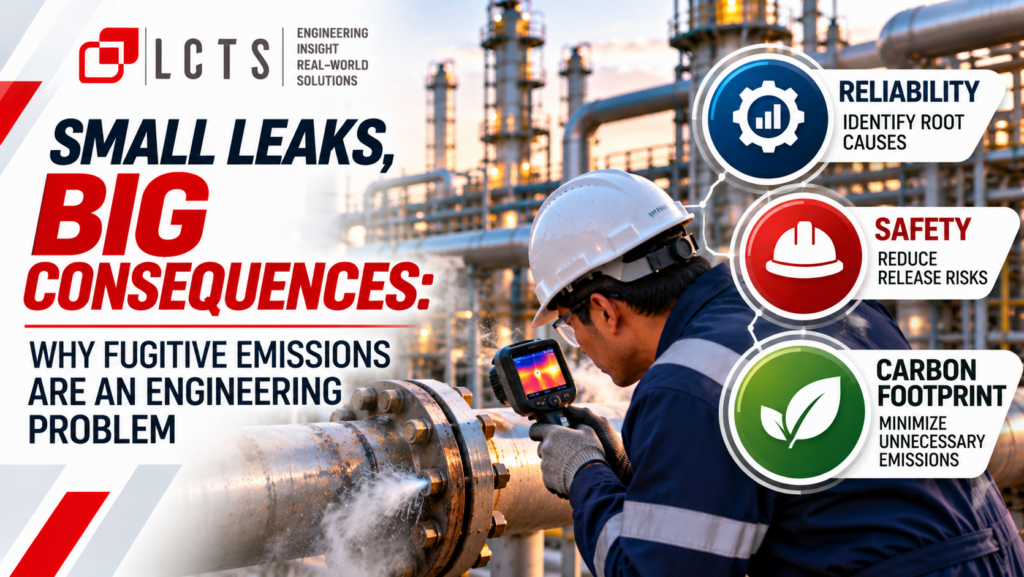
Reliability, Safety, and Carbon Footprint Come Together
This is where the three priorities connect.
Reliability: Prevent recurring equipment failures and improve asset performance.
Safety: Reduce potential exposure to hazardous releases and identify developing equipment problems.
Carbon footprint: Reduce unnecessary releases and improve environmental performance.
The same engineering investigation can potentially address all three.
That is why fugitive emissions deserve to be considered within the broader asset-management strategy.
The LCTS Perspective
At Lucke Consulting Technology Services (LCTS), we believe environmental performance should not be separated from engineering performance.
A facility’s carbon footprint is influenced by how its equipment operates, how well assets are maintained, and how effectively technical risks are managed.
Fugitive emissions provide a good example.
A leak may be an emissions issue—but it may also be a warning about equipment condition, reliability, or process risk.
The goal is not simply to find the leak.
The goal is to understand the engineering reason behind it.
Final Thought
Industrial facilities are complex systems made up of thousands of components.
Some of the most important engineering opportunities may come from problems that appear small.
A leaking seal.
A deteriorating gasket.
A recurring valve failure.
Individually, they may seem minor.
Collectively, they can affect reliability, safety, operating cost, and carbon footprint.
Good engineering looks beyond the immediate symptom to understand the bigger picture.
How LCTS Can Help
LCTS provides independent engineering insight to help industrial organizations evaluate asset performance, technical risks, reliability challenges, and opportunities to improve operational and environmental performance.
If a recurring leak is treated as only a maintenance problem, the underlying engineering issue may remain.
Contact LCTS to take a closer look at the problem behind the problem.
LCTS — Engineering Insight. Real-World Solutions.