LCTS Industry Insight
Industrial companies are under increasing pressure to reduce emissions and improve their carbon performance. New technologies, alternative fuels, electrification, carbon-management systems, and process modifications are creating opportunities to lower emissions across the asset lifecycle.
But every major change to an industrial facility introduces another question:
Are we creating new risks while trying to solve an existing one?
Decarbonization is not simply an environmental initiative. It is an engineering transformation—and engineering transformation must be approached with safety and reliability in mind.
A Lower-Carbon Solution Is Not Automatically a Lower-Risk Solution
Changing a process can change how a facility behaves.
New equipment may introduce different operating conditions. New energy sources may require different controls. Changes to existing systems can affect pressure, temperature, materials, utilities, instrumentation, or emergency-response requirements.
A project may achieve its emissions objective while creating technical challenges that were not present before.
That does not mean decarbonization should be avoided.
It means the engineering evaluation needs to happen before the change becomes irreversible.
New Technology Requires New Engineering Questions
When organizations introduce unfamiliar technologies, historical operating experience may not always provide all the answers.
Engineers need to understand:
How will the new system interact with existing equipment?
What happens during abnormal conditions?
What happens when the system fails?
Are existing safeguards still appropriate?
Will operators need different procedures or training?
These questions become particularly important when new technology is integrated into an existing industrial facility.
Reliability Cannot Be an Afterthought
A decarbonization project may look successful on paper, but its long-term value depends on whether the facility can operate reliably.
If a new system introduces frequent failures, difficult maintenance requirements, or unexpected process limitations, the intended benefits can quickly become more complicated.
Reliability needs to be considered during design—not after commissioning.
A technically sound solution should be capable of delivering its intended environmental benefits without compromising the availability and performance of the facility.
Safety Must Move With the Technology
Industrial safety systems are designed around specific processes, equipment, materials, and operating conditions.
When those conditions change, the safety strategy may need to change with them.
This is why process safety should not be treated as a final project review.
It should be part of the engineering process from the beginning.
The earlier potential hazards are identified, the more opportunities the project team has to address them through design.
The Importance of Brownfield Thinking
Many decarbonization projects will not happen on empty sites.
They will be integrated into facilities that are already operating.
That makes the challenge more complex.
Existing equipment, utilities, piping, controls, access limitations, operating schedules, and maintenance requirements all have to be considered.
A new technology may work perfectly in isolation but create unexpected challenges when connected to an existing system.
The facility must be evaluated as a whole.
The LCTS Perspective
At Lucke Consulting Technology Services (LCTS), we believe decarbonization should be approached through the same engineering principles that guide reliable and safe industrial operations.
Reducing carbon footprint is important.
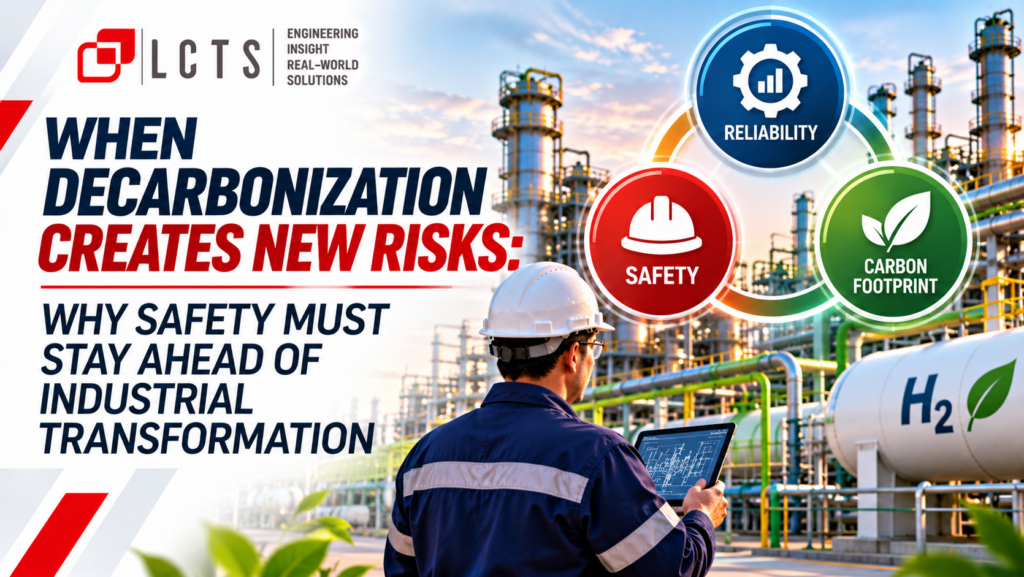
But the strongest solution is one that considers carbon performance, reliability, and safety together.
Before implementing a major technical change, organizations should understand not only what the technology can achieve, but also how it will behave within the existing asset.
Final Thought
The industrial transition toward lower-carbon operations will require significant engineering innovation.
But innovation should not mean abandoning the fundamentals.
Reduce emissions. Protect people. Maintain reliability.
The most successful decarbonization projects will be those that accomplish all three.
Because the goal is not simply to make an industrial facility lower-carbon.
The goal is to make it lower-carbon, safe, and reliable.
How LCTS Can Help
Decarbonization projects can involve complex technical decisions, particularly when new technologies must be integrated into existing industrial assets.
LCTS provides engineering insight to help organizations evaluate technical decisions, identify risks, and understand how proposed changes may affect reliability, safety, and overall asset performance.
Before implementing the next major change, make sure the engineering case is as strong as the sustainability case.
LCTS — Engineering Insight. Real-World Solutions.