LCTS Industry Insight
When industrial companies think about reducing their carbon footprint, the conversation usually turns to energy efficiency, electrification, renewable energy, or process optimization.
But there is another factor that is often overlooked:
Maintenance.
The way equipment is inspected, maintained, repaired, and operated can influence not only reliability, but also energy consumption, emissions, safety, and the overall performance of an industrial facility.
A maintenance strategy is therefore more than a way to prevent equipment failure.
It can also be part of an organization’s carbon strategy.
Reliability Starts Before Failure
The traditional view of maintenance is often reactive: equipment fails, the problem is identified, and repairs are made.
But unexpected failures can have consequences beyond the immediate repair.
A failed pump, compressor, heat exchanger, or rotating asset can disrupt production, require emergency intervention, and force equipment or processes to operate under less-than-ideal conditions.
These disruptions can increase energy consumption and create additional operational risks.
A more proactive approach focuses on understanding equipment condition and identifying developing problems before they become failures.
Preventing failure is often more efficient than recovering from it.
Poor Equipment Condition Can Increase Energy Use
Equipment does not always fail suddenly.
Performance can deteriorate gradually.
A pump may require more power.
A heat exchanger may lose thermal performance.
A compressor may operate less efficiently.
A furnace may require more fuel to achieve the same process result.
These changes may initially appear to be minor operating issues.
Over time, however, they can increase energy consumption and operating costs while reducing the efficiency of the overall process.
This is where maintenance and carbon performance begin to overlap.
Reliability and Carbon Footprint Are Connected
A reliable asset operates predictably.
Predictable operation makes it easier to maintain process conditions, plan maintenance, and identify abnormal performance.
Unplanned failures can create the opposite effect.
Emergency repairs, repeated startups and shutdowns, temporary operating conditions, and inefficient equipment operation can all affect the facility’s overall performance.
The connection is straightforward:
Better asset health can support better operational efficiency.
And better efficiency can contribute to lower unnecessary emissions.
Safety Cannot Be Left Out
There is another reason maintenance strategy matters.
Equipment degradation can also become a safety concern.
Loss of containment, equipment failure, deteriorating protective systems, or malfunctioning controls can introduce hazards that go beyond production losses.
This means maintenance decisions need to consider more than cost and uptime.
The question should also be:
What happens if this equipment condition continues to deteriorate?
Understanding that risk early allows organizations to make better decisions about inspection, repair, replacement, and operational controls.
Not Every Asset Needs the Same Maintenance Strategy
A common mistake is treating every piece of equipment the same way.
Not every asset has the same consequence of failure.
Some failures may result primarily in lost production.
Others may affect safety, environmental performance, or multiple interconnected systems.
That is why maintenance strategies should consider the criticality of the asset, its operating conditions, its failure modes, and the consequences of failure.
The objective is not simply to maintain everything more frequently.
It is to maintain the right assets in the right way at the right time.
The Value of Looking at the Whole Asset
Modern monitoring and predictive technologies can provide valuable information about equipment condition.
But technology alone does not determine the best maintenance decision.
Engineers still need to understand what the information means within the context of the process.
A change in vibration, temperature, pressure, power consumption, or performance may indicate a developing issue—but determining the appropriate response requires technical judgment.
Sometimes the right answer is maintenance.
Sometimes it is optimization.
Sometimes it is equipment replacement.
And sometimes continued monitoring is the most appropriate decision.
Good maintenance strategy starts with understanding the asset, not simply reacting to an alarm.
The LCTS Perspective
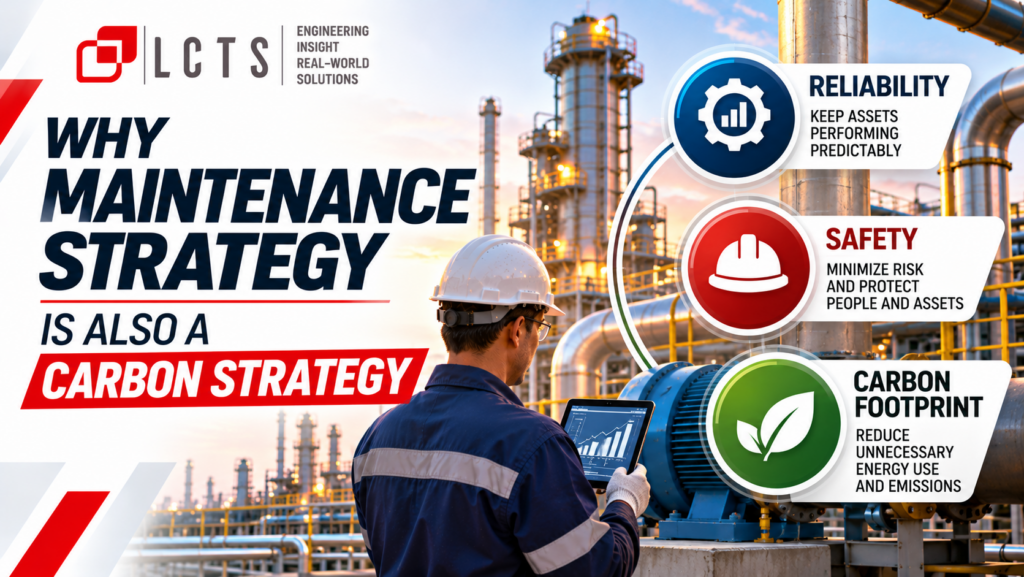
At Lucke Consulting Technology Services (LCTS), we believe reliability, safety, and carbon performance should be considered together.
Maintenance should not be viewed only as an expense required to keep equipment operating.
It can be an opportunity to improve asset performance, reduce operational risk, and identify sources of unnecessary energy consumption.
When organizations understand how equipment condition affects the broader process, maintenance decisions can become more strategic.
Reliable assets support stable operations.
Safe assets protect people and facilities.
Well-performing assets can reduce unnecessary energy consumption.
The connection deserves attention.
Final Thought
Carbon reduction does not always begin with a new technology or a major capital project.
Sometimes it begins with an asset that is already in the facility.
Understanding why equipment is consuming more energy, performing differently, or experiencing repeated problems can reveal opportunities that are easy to overlook.
Maintenance keeps equipment running.
Engineering determines how well it runs.
And when those two disciplines work together, reliability, safety, and carbon performance can move in the same direction.
How LCTS Can Help
LCTS provides independent engineering insight to help industrial organizations evaluate asset performance, reliability concerns, operational risks, and improvement opportunities.
Before treating maintenance as simply a cost of doing business, consider what better asset performance could mean for reliability, safety, and carbon footprint.
Contact LCTS to discuss your engineering challenge.
LCTS — Engineering Insight. Real-World Solutions.