Industrial facilities are entering a new era of digital transformation.
Across refineries, petrochemical plants, and process industries, companies are investing in new technologies designed to improve efficiency, reliability, and decision-making. Artificial intelligence, advanced analytics, automation, and digital monitoring systems are becoming increasingly common.
But successful technology adoption is not simply a matter of installing new software or connecting new equipment.
The real challenge is integration.
The question companies should ask is not only:
“Can this technology work?”
The more important question is:
“Can this technology work effectively within our existing operation?”
The Reality of Existing Industrial Assets
Many industrial facilities were built and expanded over decades.
These facilities often contain a combination of:
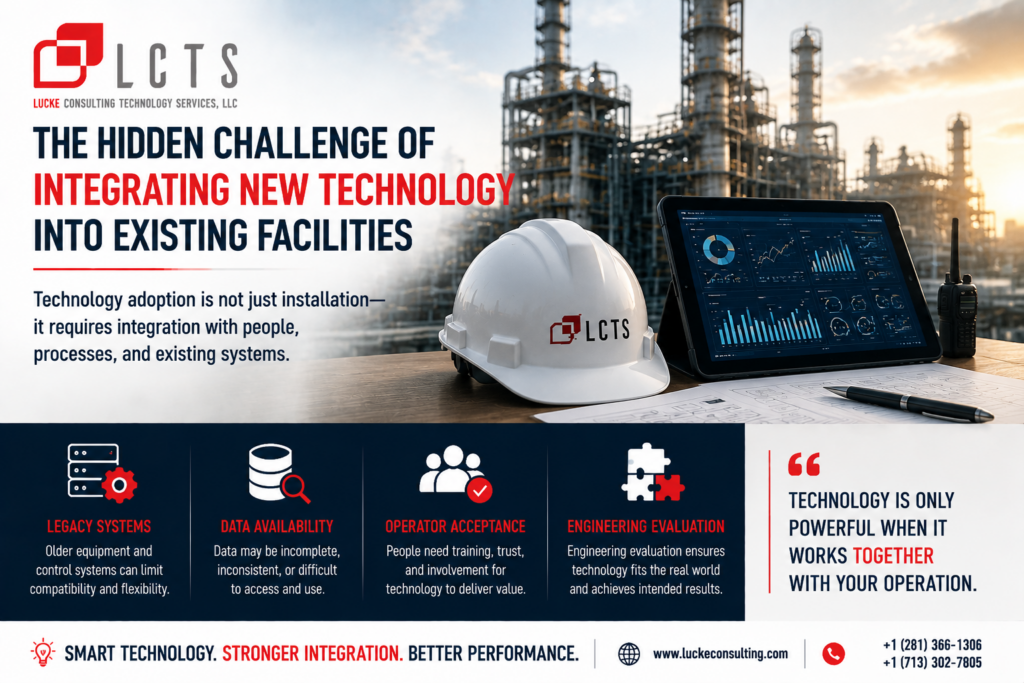
- Legacy control systems
- Older instrumentation
- Multiple generations of equipment
- Different data platforms
- Established operating practices
While these systems may continue to perform reliably, they were not always designed for today’s digital requirements.
Adding new technology into an existing environment requires understanding how new solutions interact with the systems already in place.
Without proper evaluation, companies may create disconnected tools rather than meaningful improvements.
Data Availability Is Not Always the Same as Data Quality
Many digital initiatives depend on one critical element:
Data.
However, having large amounts of data does not automatically create value.
Industrial data can face challenges such as:
- Missing information
- Inconsistent measurements
- Different data formats
- Limited historical records
- Incorrect assumptions about process behavior
Advanced analytics and AI tools can only provide reliable insights when the information behind them is accurate and properly understood.
This is where engineering knowledge becomes essential.
Understanding what the data represents—and what it does not represent—is critical for making the right decisions.
Technology Must Work With People, Not Around Them
One of the most overlooked parts of technology adoption is the human element.
Operators and engineers understand the facility in ways that data alone cannot capture.
Successful implementation requires:
- Operator involvement
- Practical training
- Clear workflows
- Trust in new systems
- Alignment between technology and daily operations
A technically advanced solution will not deliver value if it does not fit the way people operate the facility.
Technology should support decision-making—not create additional complexity.
Why Engineering Evaluation Matters
Before implementing new digital tools, companies need to understand the operational environment where the technology will be applied.
Engineering evaluation helps determine:
- Where technology can provide real value
- What limitations exist within current systems
- How new solutions integrate with existing processes
- What risks may appear during implementation
The goal is not simply adopting the newest technology.
The goal is selecting and integrating technology that improves operational performance.
The Future of Industrial Digitalization Requires Integration
The next generation of industrial operations will rely on the combination of:
- Advanced technology
- Reliable data
- Engineering expertise
- Operational experience
Companies that succeed will not be those that simply adopt more tools.
They will be the ones that understand how technology fits into the bigger operational picture.
How LCTS Supports Technology Integration
At Lucke Consulting Technology Services (LCTS), we help clients evaluate complex industrial challenges by combining engineering experience with modern analytical approaches.
Our focus is helping organizations:
- Understand existing system limitations
- Evaluate operational opportunities
- Improve decision confidence
- Integrate solutions that support long-term performance
Because successful transformation is not about adding more technology.
It is about making technology work within the reality of industrial operations.
Final Thought
Digital transformation in industrial facilities is not a technology problem alone.
It is an integration challenge.
The strongest results come when technology, engineering, and operational knowledge work together to create solutions that are practical, reliable, and sustainable.
📨 Got questions? Message us on LinkedIn—we’re ready to help.
📌 Contact us:
📞 +1 (281) 366-1306 | +1 (713) 302-7805
📧 elucke@luckeconsulting.com | sspears@luckeconsulting.com