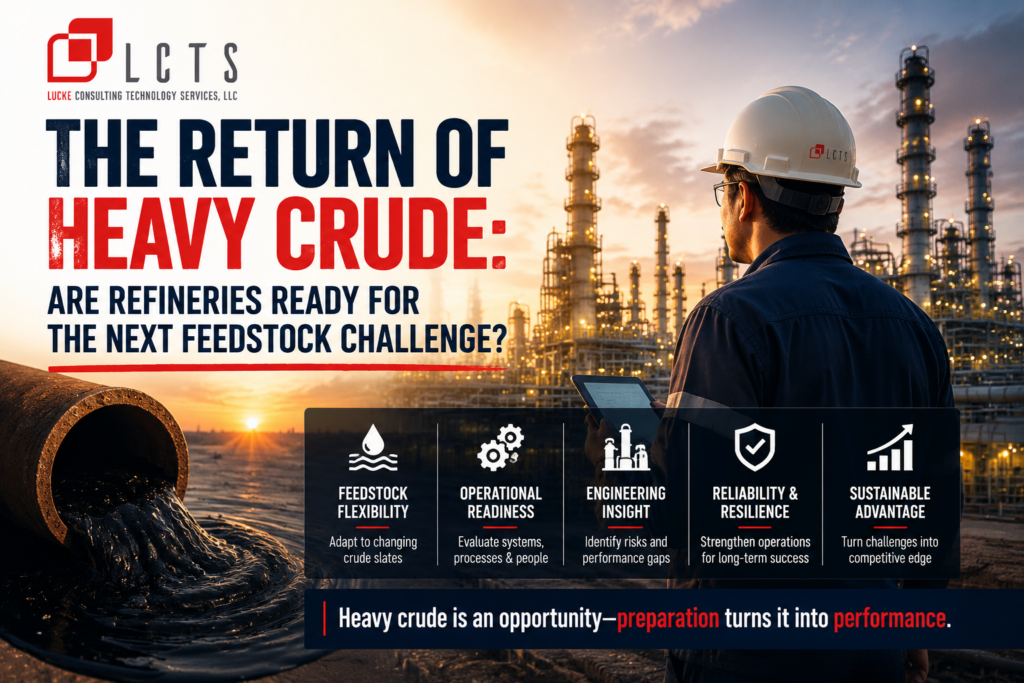
The Return of Heavy Crude: Are Refineries Ready for the Next Feedstock Challenge?

For decades, many Gulf Coast refineries built their competitive advantage around one capability: the ability to process heavy crude oil.

Complex refinery configurations, including delayed cokers, sulfur recovery units, and upgrading facilities, were designed specifically to handle heavier and more challenging feedstocks.

But as global markets shift and crude supply strategies continue to evolve, heavy crude is once again becoming a major topic of discussion.

The question is no longer only:

“Can refineries process heavy crude?”

The more important question is:

“Are refineries operationally ready to process it consistently?”


Heavy Crude Creates Opportunity—But Also Complexity

Heavy crude can provide economic advantages because it is often priced differently compared to lighter crude streams.

For refineries equipped to handle it, this creates opportunities for improved margins and feedstock flexibility.

However, heavy crude also introduces additional operational challenges:

  • Higher sulfur content
  • Increased asphaltenes
  • More residual material
  • Greater coke formation potential
  • Higher demands on processing units

The refinery may have the equipment—but successful operation depends on much more than equipment capability.


Design Capability Does Not Always Equal Operational Readiness

A refinery can be designed to process a specific crude slate, but real-world performance depends on many factors:

  • Current operating practices
  • Equipment condition
  • Process knowledge
  • Maintenance strategy
  • Operator experience

Over time, operating conditions change. Workforce experience changes. Processes evolve.

A unit that operated successfully decades ago may face different challenges today.

This is why feedstock changes require more than a commercial decision.

They require an engineering and operational assessment.


The Importance of Experience in Complex Processing

Heavy crude processing relies heavily on experience.

Understanding how a facility responds to changes in feed quality, operating conditions, and unit interactions requires knowledge that is often developed through years of operation.

As experienced refinery professionals retire, companies face a growing challenge:

How do we transfer the knowledge needed to operate increasingly complex systems?

Technology can support decision-making, but experience remains essential for understanding unexpected behaviors and identifying risks before they become operational problems.


Engineering Reviews Become More Valuable During Transitions

When feedstock strategies change, independent engineering perspectives can help identify potential challenges early.

Focused reviews can evaluate:

  • Process limitations
  • Unit integration
  • Operating assumptions
  • Reliability risks
  • Optimization opportunities

The goal is not to question existing capabilities.

The goal is to strengthen confidence before significant changes occur.


Preparing for the Next Feedstock Environment

The future of refining will likely require greater flexibility.

Facilities that succeed will be those that understand not only what their equipment can handle, but how their entire system responds under changing conditions.

Heavy crude is not simply a feedstock choice.

It is an operational strategy.

And successful strategies require alignment between technology, engineering, and people.


At Lucke Consulting Technology Services (LCTS), we help clients evaluate complex industrial challenges through process engineering, operational assessments, and independent technical reviews.

Because in a changing energy landscape, preparation is what turns uncertainty into opportunity.


📨 Got questions? Message us on LinkedIn—we’re ready to help.

📌 Contact us:
📞 +1 (281) 366-1306 | +1 (713) 302-7805
📧 elucke@luckeconsulting.com | sspears@luckeconsulting.com
🌐 www.luckeconsulting.com

Recent Post

The Growing Importance of Process Safety in the Age of Digital Transformation

Industrial facilities are becoming smarter.

Across refineries, petrochemical plants, and process industries, companies are investing in automation, artificial intelligence, advanced analytics, and digital monitoring systems to improve efficiency and decision-making.

These technologies are transforming how facilities operate.

However, as industrial systems become more connected and complex, one principle remains unchanged:

Technology must always support safe operations.

The future of industrial performance is not only about operating faster or more efficiently.

It is about ensuring that improvements are made without increasing operational risk.

This is why process safety is becoming even more important in the age of digital transformation.

Digital Transformation Creates New Opportunities—and New Challenges

Modern digital tools provide significant benefits:

Improved visibility into operations
Faster access to critical information
Better monitoring of equipment performance
Early identification of potential issues
More informed decision-making

However, introducing new technology into industrial environments also creates new considerations.

Facilities must evaluate:

How systems interact with existing operations
How data is collected and interpreted
How automation affects operator decisions
How changes impact safety procedures

Digital transformation is not only a technology upgrade.

It is an operational change.

Automation Does Not Replace Process Safety Responsibilities

Automation has improved industrial reliability by reducing manual tasks and providing operators with better information.

However, automation does not eliminate the need for engineering judgment.

Complex industrial systems still require people who understand:

Process behavior
Equipment limitations
Operating conditions
Potential failure scenarios

A control system can identify an abnormal condition.

An experienced engineer or operator understands what that condition means and what action should follow.

The Importance of Managing Change

One of the most critical aspects of digital transformation is understanding how changes affect existing operations.

Even beneficial improvements can introduce unexpected risks if they are not properly evaluated.

Changes involving:

New software systems
Updated control strategies
Additional instrumentation
Automated decision tools
Modified operating procedures

must be carefully reviewed.

This is where disciplined engineering practices, including Management of Change (MOC), become essential.

Data Improves Decisions—but Context Creates Understanding

Digital systems generate more information than ever before.

Sensors, analytics platforms, and monitoring tools provide valuable operational insights.

But data alone does not guarantee better decisions.

Engineers must still determine:

Is the information accurate?
Does it represent actual process conditions?
What risks are associated with the situation?
What action is appropriate?

Process safety depends not only on having information, but on understanding it.

The Human Element Remains Critical

As technology advances, the role of engineers and operators continues to evolve.

The future industrial workforce must combine:

Digital capability
Process knowledge
Safety awareness
Practical experience

Technology can support decisions.

But people remain responsible for evaluating consequences and making sound operational choices.

Why Independent Engineering Perspective Matters

As industrial facilities become more complex, having an independent perspective can help identify risks that may be overlooked.

Technical reviews can help evaluate:

Process safety considerations
System integration challenges
Operational impacts
Potential failure points

The objective is not to slow innovation.

It is to ensure innovation improves operations safely.

How LCTS Supports Safer Industrial Decisions

At Lucke Consulting Technology Services (LCTS), we help clients navigate complex industrial challenges through engineering expertise, technical reviews, and operational assessments.

Our approach combines:

Process understanding
Engineering experience
Risk evaluation
Practical operational insight

Because successful digital transformation requires more than implementing technology.

It requires making sure technology supports safe, reliable, and sustainable operations.

Final Thought

Digital transformation is changing the future of industrial operations.

But the foundation of every successful facility remains the same:

Safe decisions, reliable processes, and engineering judgment.

The smartest facilities will not simply be the most automated.

They will be the ones that successfully combine technology with process safety.

Read More »

The Challenge of Managing Multiple Generations of Industrial Technology

Modern industrial facilities often combine decades-old equipment with advanced digital technologies. While this creates opportunities for improvement, it also introduces challenges in integration, data management, and operational reliability. LCTS explores why successfully managing multiple generations of technology requires engineering expertise, strategic evaluation, and a practical approach to modernization.

Read More »

Why Delaying Refinery Turnarounds Can Create Bigger Operational Risks

Refinery turnarounds are essential for maintaining safe and reliable operations, but delaying them can introduce hidden risks. As facilities push for longer operating cycles, companies must carefully balance production goals with equipment reliability, asset integrity, and long-term performance.

LCTS explores why risk-based planning, engineering insight, and proactive decision-making are critical to managing turnaround challenges and protecting industrial operations.

Read More »