
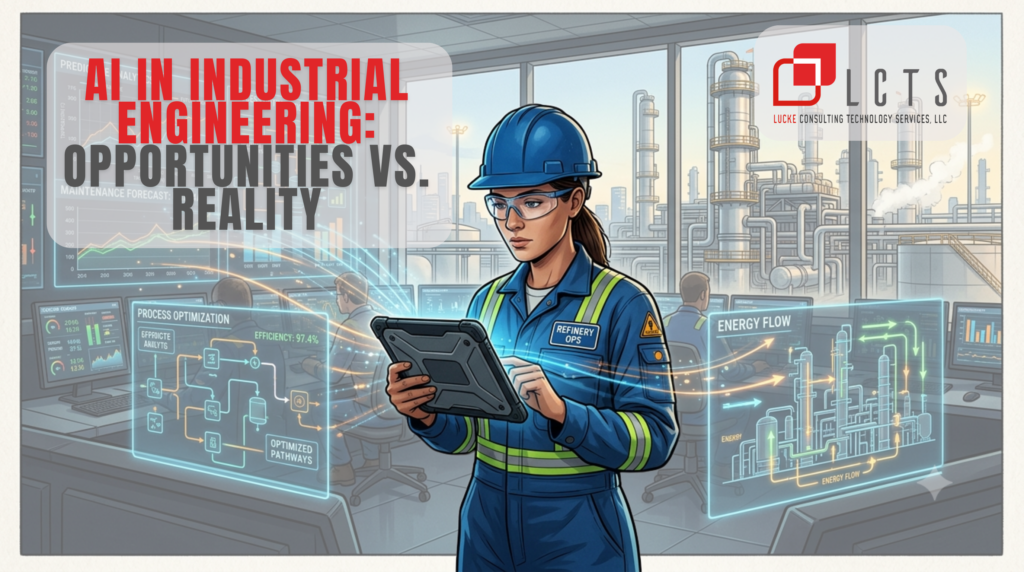
Artificial intelligence (AI) is transforming the way industries operate, and engineering is no exception. From process optimization to predictive maintenance, AI promises efficiency, speed, and data-driven insight.
But for complex industrial operations—refineries, petrochemical plants, and other process-intensive facilities—AI is not a magic solution. While it can automate calculations, identify patterns, and assist with simulations, it cannot replace human judgment, operational experience, or system-level understanding.
What AI Can Do
AI is highly effective in areas where patterns are consistent and data is structured. In industrial engineering, it can:
- Analyze large datasets quickly for trends or anomalies
- Simulate process scenarios based on predefined inputs
- Optimize control parameters for energy or resource efficiency
- Support predictive maintenance by identifying equipment at risk
- Assist in planning and scheduling repetitive operational tasks
These capabilities can save time, improve throughput, and reduce errors in calculations or monitoring.
What AI Cannot Do
Complex industrial systems operate in dynamic, interconnected, and sometimes unpredictable environments. AI has limitations:
- It cannot fully understand system interdependencies or nuanced interactions between process units.
- It cannot evaluate the practical implications of design assumptions in real operations.
- It cannot interpret unexpected events that fall outside historical data patterns.
- It cannot replace the experience-based decision-making that comes from years of working on real plants.
In other words, AI can assist—but it cannot replace the engineer who understands context, risk, and operational constraints.
Human Expertise Remains Essential
Even the most advanced AI tools rely on quality input data and proper interpretation. Human engineers provide:
- Validation of AI-generated recommendations
- Judgment under uncertainty
- Integration of cross-disciplinary knowledge
- Awareness of operational and safety constraints
AI excels as a tool in the engineer’s toolkit—but complex decisions, especially during FEED, commissioning, or startup, still depend on human oversight.
How LCTS Leverages AI Without Replacing Human Judgment
At Lucke Consulting Technology Services, we use AI to support our engineering teams, not replace them.
Our approach combines:
- Data-driven insights for process optimization
- Predictive analytics for operational efficiency
- Human oversight for safety, system integration, and judgment-based decisions
This balance ensures that clients gain efficiency and innovation, without compromising the critical expertise that makes industrial projects successful.
Final Thought
AI is a powerful enabler for industrial engineering—but it is not a substitute for human experience and judgment. The best outcomes are achieved when AI and engineers work together, leveraging data while applying context, insight, and real-world knowledge to every decision.
📨 Got questions? Message us on LinkedIn—we’re ready to help.
📌 Contact us:
📞 +1 (281) 366-1306 | +1 (713) 302-7805
📧 elucke@luckeconsulting.com | sspears@luckeconsulting.com
🌐 www.luckeconsulting.com