
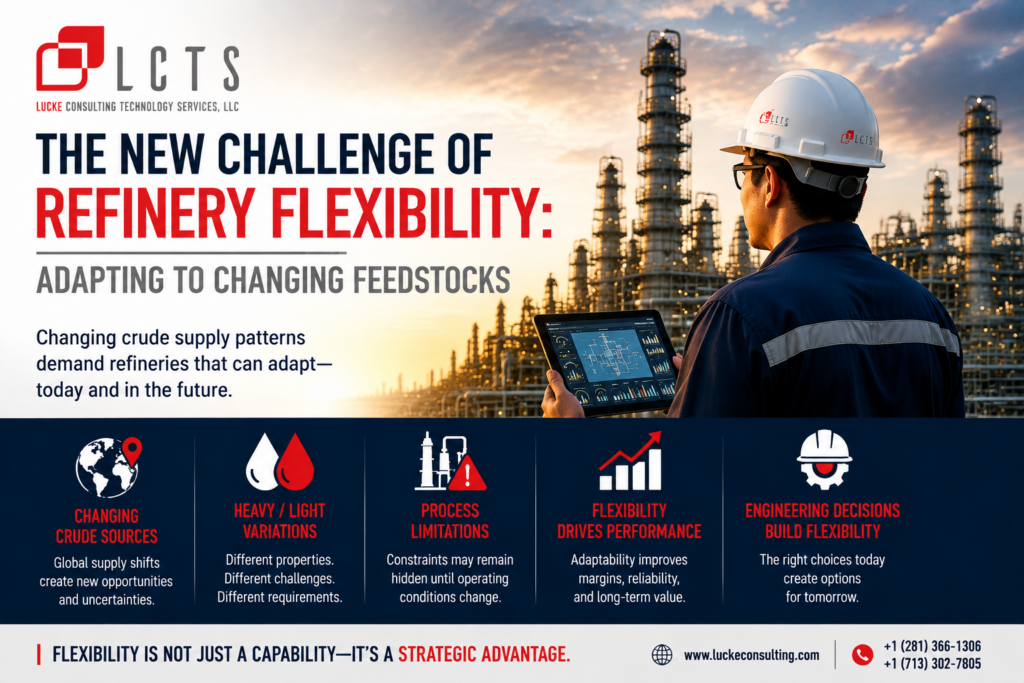
The refining industry has always been shaped by one fundamental challenge: converting available crude oil into valuable products efficiently and reliably.
However, the definition of “available crude” is changing.
Global supply patterns, market conditions, geopolitical shifts, and evolving production strategies are creating a more dynamic feedstock environment. Refineries that were once optimized around a specific crude slate are now facing a new question:
How flexible is the facility when feedstock conditions change?
In today’s environment, refinery success is no longer only about maximizing capacity. It is about the ability to adapt.
The Changing Reality of Crude Supply
Historically, many refineries were designed around predictable feedstock characteristics. Equipment selection, operating strategies, and process configurations were optimized based on expected crude properties.
But global markets continue to evolve.
Refineries may increasingly encounter:
- Different crude origins and supply routes
- Variations in crude quality
- Changes in heavy and light crude availability
- Increased uncertainty in long-term feedstock planning
These changes create opportunities—but they also introduce operational challenges.
A refinery that can adapt quickly has a significant advantage.
Heavy and Light Crude Present Different Challenges
Not all crude oils behave the same.
Light crude typically contains higher proportions of lighter hydrocarbons, while heavier crude contains more complex molecules, higher sulfur content, and greater quantities of residual materials.
These differences affect:
- Processing requirements
- Unit loading
- Energy consumption
- Product yield
- Equipment performance
A refinery designed around one feedstock profile may experience limitations when processing a significantly different crude slate.
The challenge is not simply whether a refinery can process a different crude.
The challenge is whether it can do so efficiently, safely, and consistently.
Process Limitations Are Often Hidden Until Conditions Change
Many operational constraints do not appear during normal conditions.
They become visible when:
- Feedstock quality changes
- Units operate outside their original design range
- Equipment approaches capacity limits
- Process interactions create unexpected behavior
This is where engineering understanding becomes critical.
A refinery may have the physical equipment to handle different feeds, but successful operation depends on understanding the relationships between:
- Process units
- Utilities
- Control systems
- Equipment limitations
- Operating practices
Flexibility requires more than capability—it requires confidence.
Flexibility Starts With Engineering Decisions
The foundation of refinery flexibility is established long before operations begin.
Early engineering decisions influence:
- Equipment selection
- Process configuration
- Operating range
- Integration between units
- Future expansion opportunities
When flexibility is considered during front-end engineering, facilities are better positioned to adapt to changing market conditions.
When flexibility is overlooked, limitations can become embedded into the design.
The Role of Engineering Insight in a Changing Industry
As the refining landscape continues to evolve, owners need more than technical solutions—they need confidence that their facilities can respond to uncertainty.
Engineering assessments, process reviews, and independent evaluations help identify:
- Current operating limitations
- Future feedstock opportunities
- Potential reliability concerns
- Optimization opportunities
The goal is not simply to process more crude.
The goal is to create operations that can adapt successfully as conditions change.
How LCTS Supports Refinery Flexibility
At Lucke Consulting Technology Services (LCTS), we help clients evaluate complex refinery challenges through:
- Process optimization studies
- Independent technical reviews
- Operational assessments
- Feedstock flexibility evaluations
- Front-end engineering support
By combining engineering experience with practical operational understanding, LCTS helps clients make informed decisions in an increasingly uncertain energy environment.
Final Thought
The future of refining will not be defined only by who can process the most crude.
It will be defined by who can adapt the fastest.
Feedstock flexibility is becoming a strategic advantage—and it begins with the engineering decisions made today.
📨 Got questions? Message us on LinkedIn—we’re ready to help.
📌 Contact us:
📞 +1 (281) 366-1306 | +1 (713) 302-7805
📧 elucke@luckeconsulting.com | sspears@luckeconsulting.com