
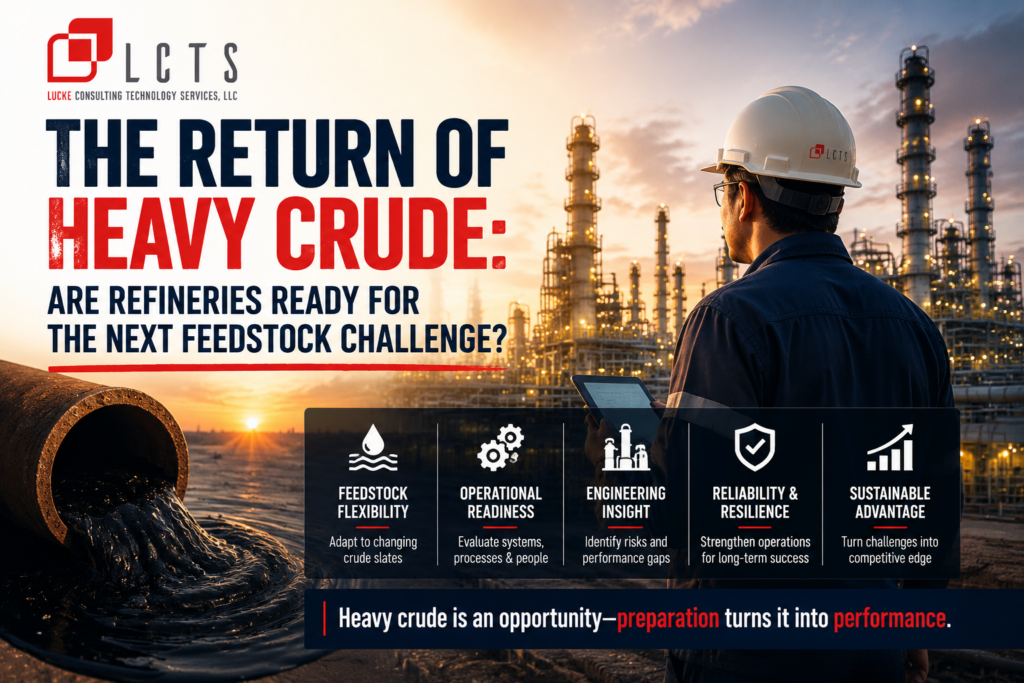
For decades, many Gulf Coast refineries built their competitive advantage around one capability: the ability to process heavy crude oil.
Complex refinery configurations, including delayed cokers, sulfur recovery units, and upgrading facilities, were designed specifically to handle heavier and more challenging feedstocks.
But as global markets shift and crude supply strategies continue to evolve, heavy crude is once again becoming a major topic of discussion.
The question is no longer only:
“Can refineries process heavy crude?”
The more important question is:
“Are refineries operationally ready to process it consistently?”
Heavy Crude Creates Opportunity—But Also Complexity
Heavy crude can provide economic advantages because it is often priced differently compared to lighter crude streams.
For refineries equipped to handle it, this creates opportunities for improved margins and feedstock flexibility.
However, heavy crude also introduces additional operational challenges:
- Higher sulfur content
- Increased asphaltenes
- More residual material
- Greater coke formation potential
- Higher demands on processing units
The refinery may have the equipment—but successful operation depends on much more than equipment capability.
Design Capability Does Not Always Equal Operational Readiness
A refinery can be designed to process a specific crude slate, but real-world performance depends on many factors:
- Current operating practices
- Equipment condition
- Process knowledge
- Maintenance strategy
- Operator experience
Over time, operating conditions change. Workforce experience changes. Processes evolve.
A unit that operated successfully decades ago may face different challenges today.
This is why feedstock changes require more than a commercial decision.
They require an engineering and operational assessment.
The Importance of Experience in Complex Processing
Heavy crude processing relies heavily on experience.
Understanding how a facility responds to changes in feed quality, operating conditions, and unit interactions requires knowledge that is often developed through years of operation.
As experienced refinery professionals retire, companies face a growing challenge:
How do we transfer the knowledge needed to operate increasingly complex systems?
Technology can support decision-making, but experience remains essential for understanding unexpected behaviors and identifying risks before they become operational problems.
Engineering Reviews Become More Valuable During Transitions
When feedstock strategies change, independent engineering perspectives can help identify potential challenges early.
Focused reviews can evaluate:
- Process limitations
- Unit integration
- Operating assumptions
- Reliability risks
- Optimization opportunities
The goal is not to question existing capabilities.
The goal is to strengthen confidence before significant changes occur.
Preparing for the Next Feedstock Environment
The future of refining will likely require greater flexibility.
Facilities that succeed will be those that understand not only what their equipment can handle, but how their entire system responds under changing conditions.
Heavy crude is not simply a feedstock choice.
It is an operational strategy.
And successful strategies require alignment between technology, engineering, and people.
At Lucke Consulting Technology Services (LCTS), we help clients evaluate complex industrial challenges through process engineering, operational assessments, and independent technical reviews.
Because in a changing energy landscape, preparation is what turns uncertainty into opportunity.
📨 Got questions? Message us on LinkedIn—we’re ready to help.
📌 Contact us:
📞 +1 (281) 366-1306 | +1 (713) 302-7805
📧 elucke@luckeconsulting.com | sspears@luckeconsulting.com
🌐 www.luckeconsulting.com